Independent heritage app · 2023 · Redeveloped in 2026
Exploring Trim Castle
An award-winning college project, developed further into an iPhone heritage app with two eras, explorable rooms and a narrated tour.
- Project
- Independent heritage app
- Disciplines
- UX & interface design · 3D · Augmented reality
- My role
- Concept, research, branding, interface design, 3D modelling, Unity development, storytelling and testing.
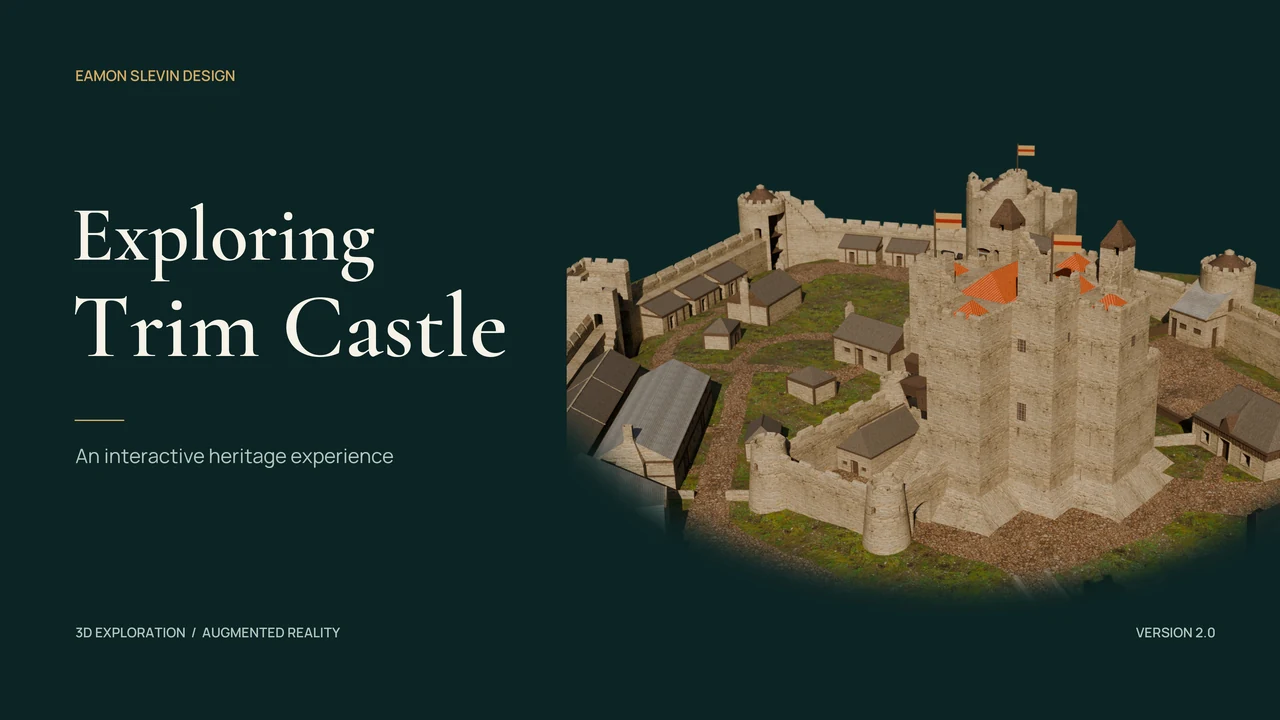
Exploring Trim Castle · Version 2.0
See the castle
come to life.
Compare the castle’s past and present, step inside reconstructed rooms and meet Hugh de Lacy on the narrated tour. This short film brings the app’s interface, 3D models and atmosphere together.
1 min 12 sec · 1080p HD · English captions available. Opens on YouTube. The app is a private development build; the film shows its models and interface, rather than live camera AR footage.
An independent heritage app
A different way
to explore the past.
Compare two eras. Step inside the rooms. Follow the story, or find your own way around.
The brief
How could a visitor understand the castle beyond the ruins they can see today? I began Exploring Trim Castle as my final-year Creative Digital Media project at TU Dublin in 2023, combining historical research, 3D modelling and augmented reality. In 2026, I returned to the project to make it a more complete, approachable experience on iPhone.
My approach
Site visits, photography and historical research informed the original models and content. The central idea remains simple: let people compare the present-day castle with a medieval interpretation. Rather than asking them to imagine everything from a description, the app connects the stories to spaces they can inspect and explore.
What I worked on
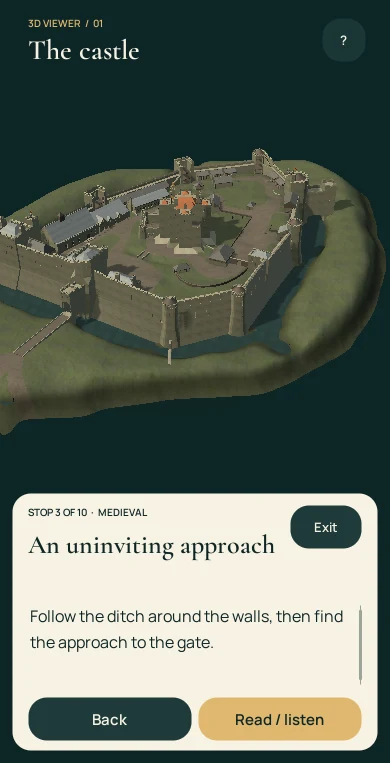
The redevelopment brought the project into Unity 6 and reworked the interface, navigation, models, lighting and audio. I developed clearer ways to choose a location, move between eras, read or listen to a story, and follow a guided route. Testing on iPhone informed refinements to AR placement, room scale, transitions and controls.
Two eras, one place
From what remains
to what might have been.
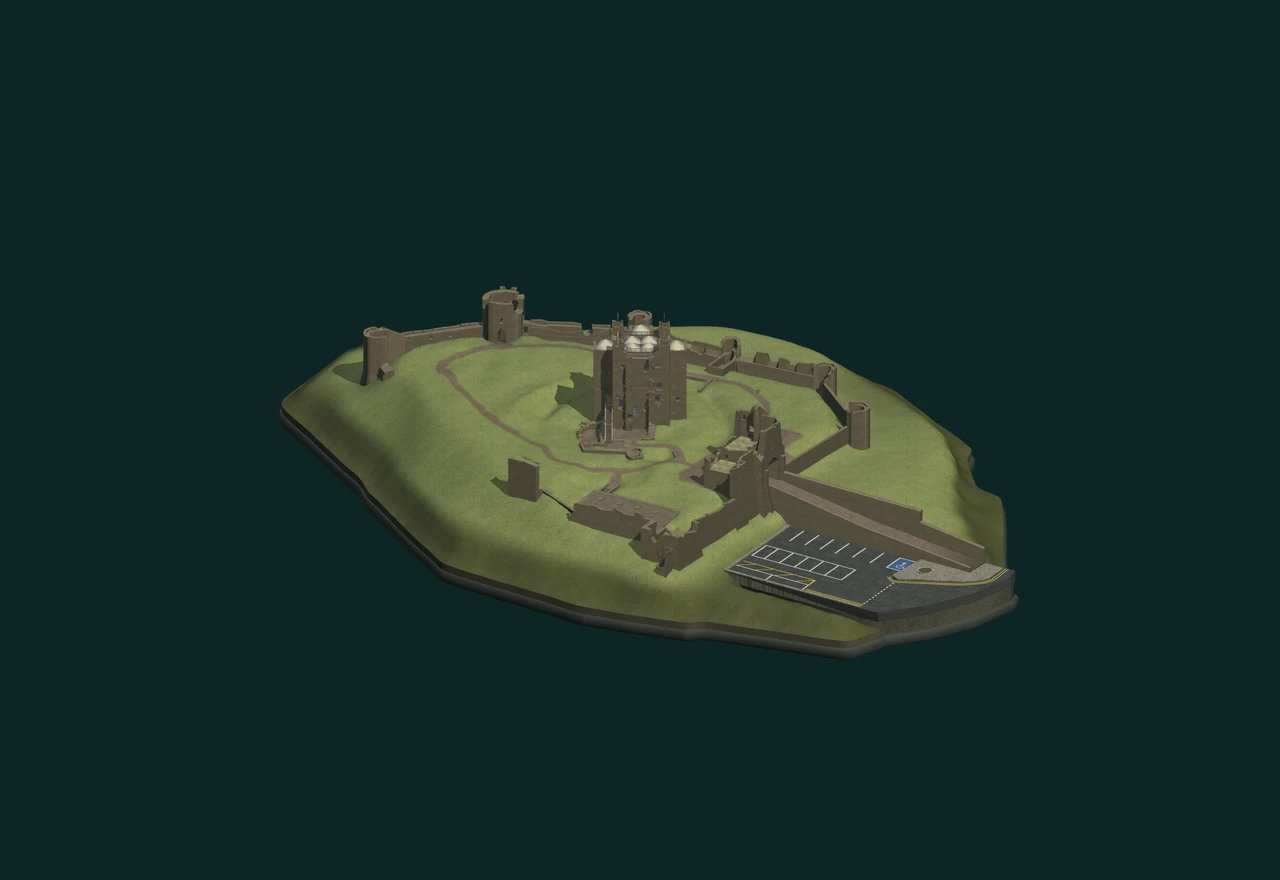
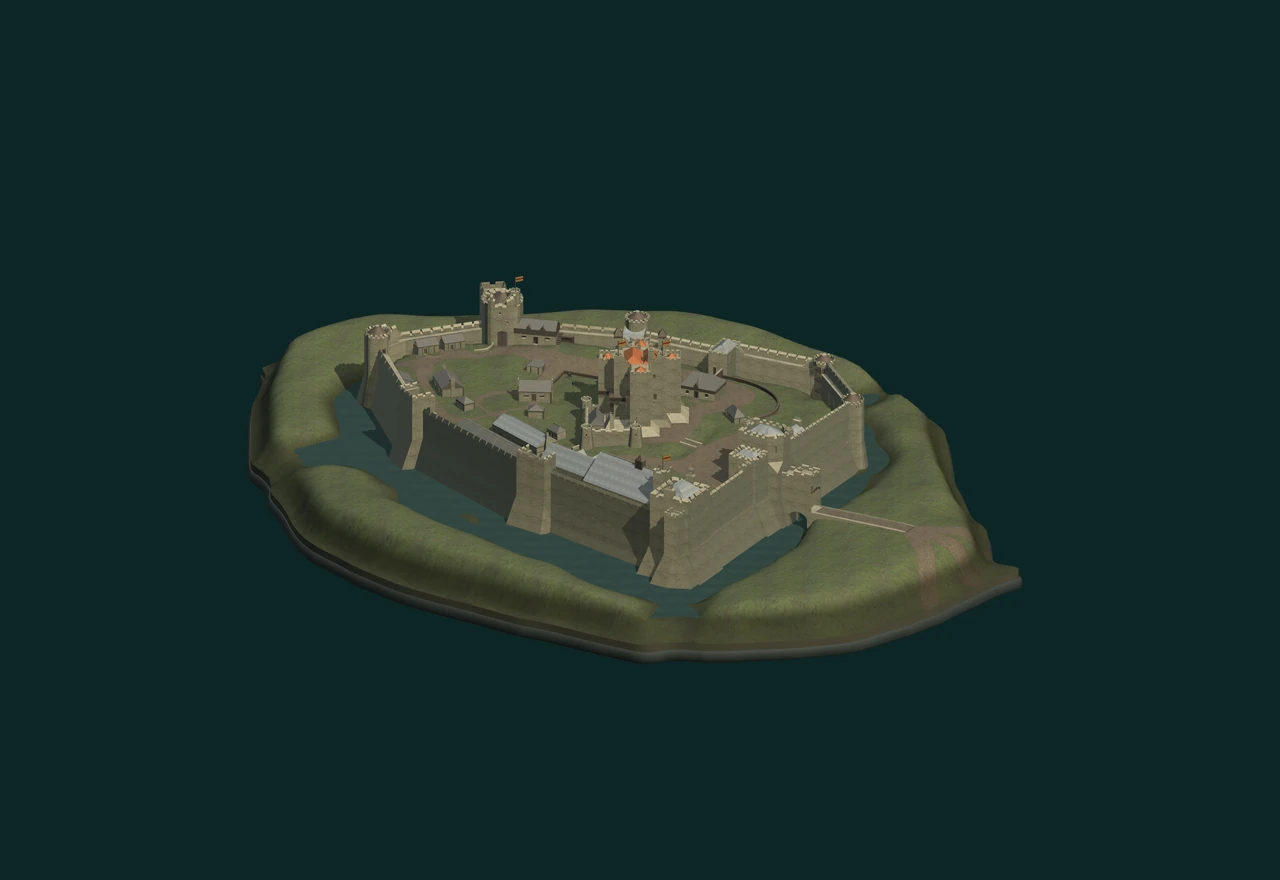
The app lets visitors switch between the surviving castle and a medieval interpretation, making the relationship between its walls, buildings and grounds easier to understand.
The scope
Research, design and a working experience.
A visual identity for heritage
A consistent identity and interface using deep green, warm cream and gold, with clear type, readable story panels and controls that leave room for the models.
Two ways to explore
An interactive 3D viewer and an AR mode for placing the castle or individual rooms in the visitor’s own surroundings.
Past-and-present comparison
Present-day and medieval versions of the castle, entrance, chamber and chapel, with reconstructed furnishings and environmental detail.
A guided narrative
A ten-stop route, short stories and character narration, with reading available alongside audio and the option to explore independently.
Atmosphere with control
Room and outdoor ambience, lighting and subtle animation, supported by sound controls, larger text and reduced-motion settings.
Iteration on a real device
Refinement of placement, camera framing, model edges, materials and scene transitions, supported by layout checks and on-phone testing.
Story, space & sound
Rooms with
a story to tell.
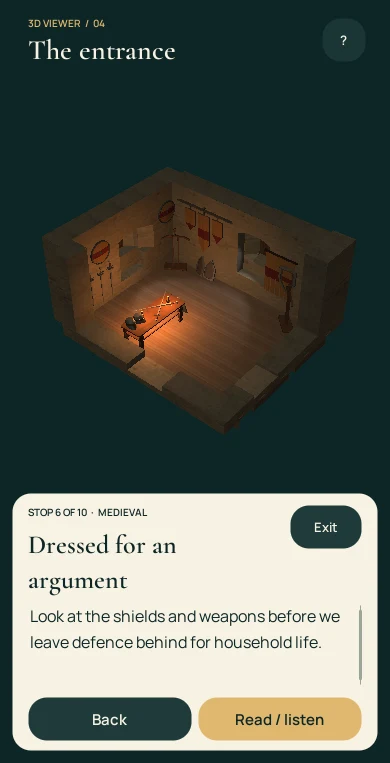
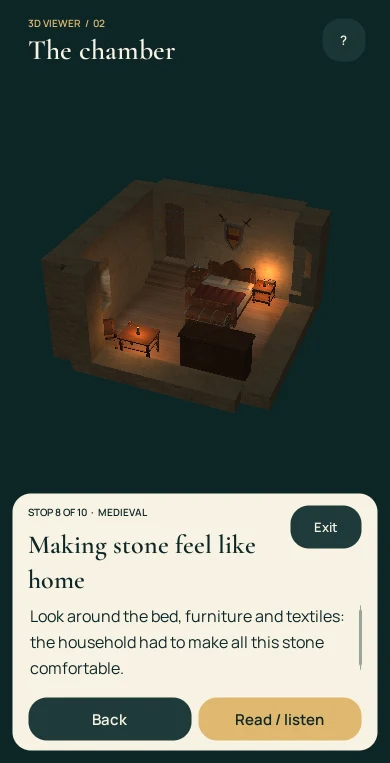
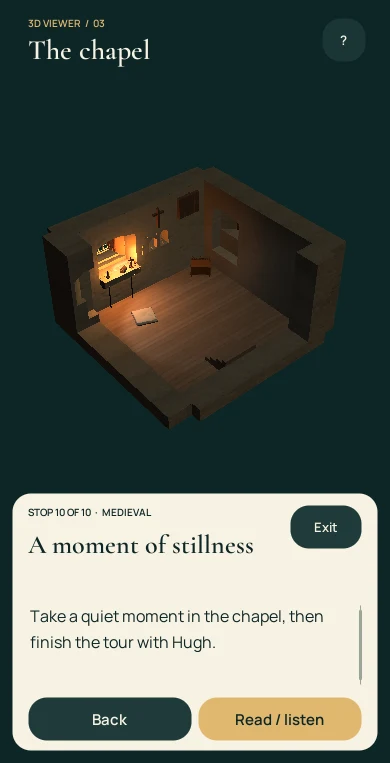
The chamber, chapel and entrance each have their own setting and stories. A ten-stop tour connects them, with a narrated Hugh de Lacy character guiding people through the experience.
Visitors can read or listen, explore freely in the 3D viewer, or place the castle and rooms in their own space through augmented reality.
Open any screen image for a larger view. Screens captured during development. Medieval interiors are interpretive reconstructions.
Designing for exploration
The interface had to make a complex 3D experience feel straightforward. I separated free exploration from the guided tour, made Today and Medieval easy to switch between, and kept read/listen controls close to each story. The visitor can choose how much guidance they want without losing the connection between the information and the model.
The detail behind the experience
The work extended beyond the main screens. I refined cutaway walls so interiors stay visible, checked rooms at different scales, improved terrain and material joins, and adjusted animation and sound so they support the setting. Repeated visual checks helped identify small defects that only appeared from particular angles or on the phone.
Presenting the experience
The Version 2.0 preview brings the project together in a 72-second film: comparing two eras, exploring the reconstructed rooms and following Hugh de Lacy’s narrated tour. The cover carries the app’s green, cream and gold identity into the film, while English captions make the spoken tour accessible without sound. It offers a way to see the models and interface while the iPhone app is still in private development.
From final-year project to working iPhone app
The original project received TU Dublin’s Best Final Year Project award, and my presentation won Best Oral Presenter at SURE 2023. The 2026 redevelopment is now installed and running as a private iPhone build, with the 3D viewer, narrated tour and AR exploration working together. Wider user testing and preparation for public release are the next stages; the original awards relate to the 2023 project.
Best Final Year Project · Best Oral Presenter, SURE 2023
Looking back
Returning to the project changed the emphasis from demonstrating what AR could do to making an experience people could comfortably use. It brings together the parts of digital work I enjoy most: research, visual design, storytelling, practical development and improving something through feedback.
The 2026 preview opens on YouTube. The original 2023 demonstration is also linked here for context.